If it ain't broke
don'tfix it.

Isn't this image so satisfying?
(o´▽`o)
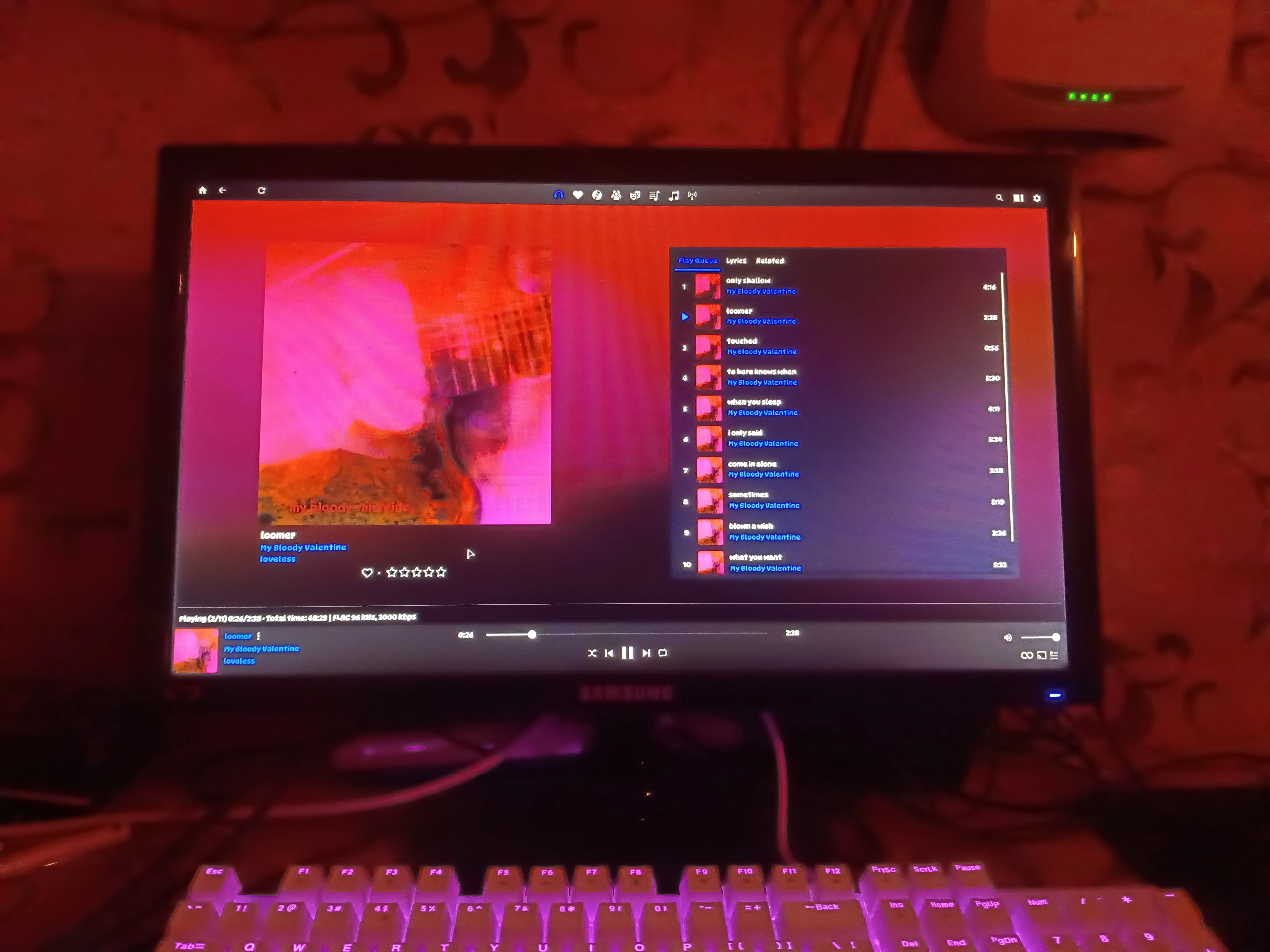
I have a huge collection of music and wanted to make the listening experience in Navidrome
better and more immersive. So I used a Philips WiZ light bulb and designed a system that smoothly transitions my
room lighting between the 5 most dominant colors of the currently playing album art to keep the experience
intimate and cohesive.
Somehow, that led me into the embedding model rabbithole. Soon enough, I had a
system where I could type a prompt like "soft relaxing bright" or "campfire" or "deep sea" or anything at all and
my room's lights would change to that. I learnt a lot of things like, why bigger model is not always better, etc.
Table of contents →
Navidrome
- I was checking my PS Vita's app store and came across this music streaming client, Nekodrome by NekoMimi which looked cooler than the Jellyfin client on PSV. That's when I thought I needed a Navidrome server. It took me some time to understand how it works and how I can make it truly mine.
- The web client was working, the PSV client was working, Android client was working. I soon discovered a problem where the metadata and artist tags were not perfect. And some albums missed Album Art. It reminded me of MusicBrainz Picard as I had seen it in GSOC organizations list. With Picard and Navidrome, one can essentially host their own music streaming service with no ads or low quality music.
- I carefully added Metadata to all my music using Picard and got Supersonic on my PC. I saw the blur in the background and thought, "How cool would it be if that background leaked outside the monitor...".
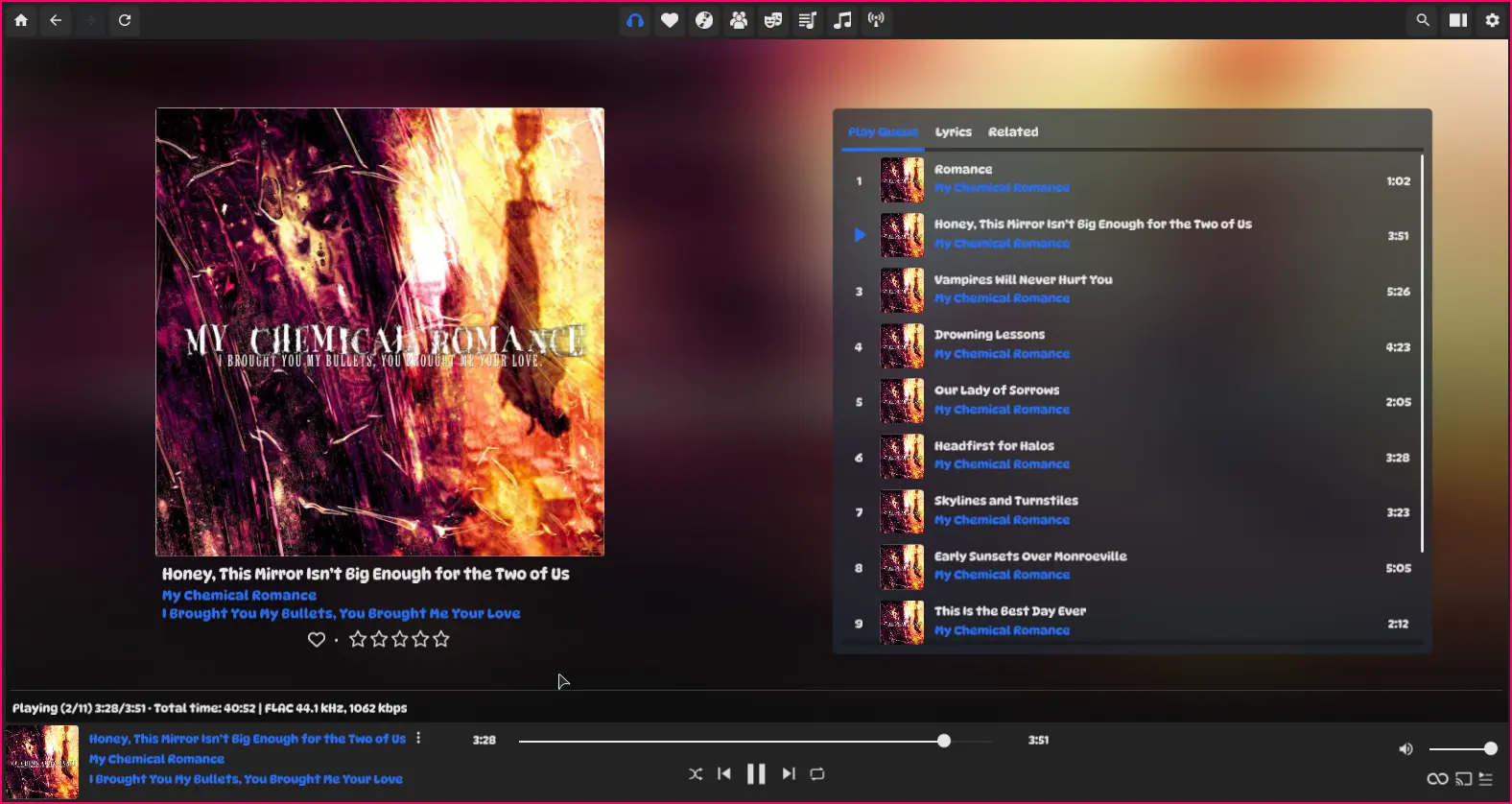
It's good that I'm immune to seizure-inducing graphics or else i'd be
(°o°:;)
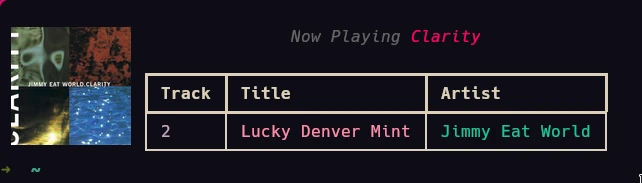
- It was time to put my WiZ Light Bulb to some use and finally making a project other than, "Oh look, my room only has light when I am typing on my keyboard. This motivates me to type more and more". I setup pywizlight in a fresh virtual environment. I also checked how Navidrome's API works and played around with cURL a bit. I was able to pipe it through jq and get track name, etc and write a shell script that could do something like this below. Check out the code here.
The Lighting
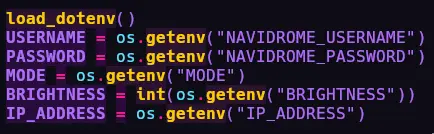
- I used the
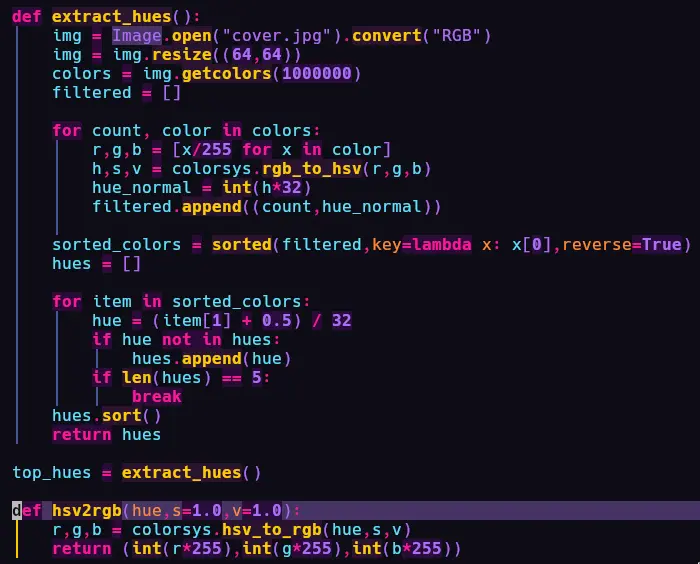
dotenvlibrary to setup the variables like so. There are 2 modes in the script. Mode 1 ends the lighting show after the current album stops playing . Whereas Mode 2 dynamically checks everytime album has changed and crossfades the colors. - Hues are extracted using pillow. First, the Album-Art image is reduced to
64x64. Then the colorspace is changed to theHSVformat. I intentionally reduced the hue resolution and cranked up saturation and brightness, so that I can get sharp colors instead of having to deal with 100 different shades of red. Now, I can have upto 32 colors as input.
32 colors here does not limit me to 32 light colors, I have a trick to get the full 16.7 million colors (^_-)
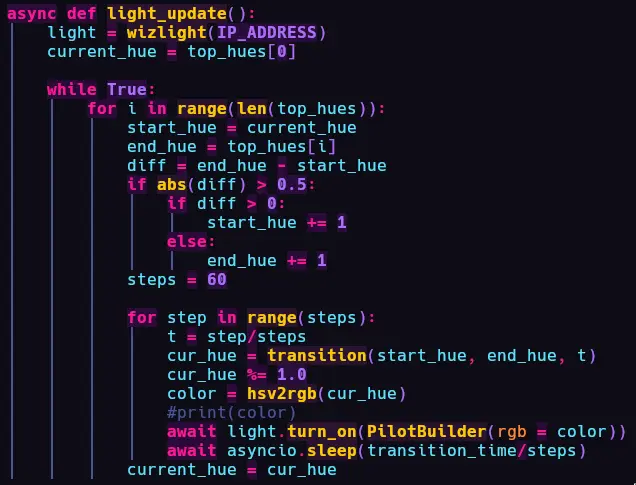
- Once we get the top 5 colors, we can use a simple for loop and go from lowest to highest (like
a gradient -> to get all colors instead of just 32) of the 5 selected hues by adding small increments. While
converting hues back to RGB (that's the format pywizlight works with) I hardcoded the Saturation
and Brightness values to 1.0 because I did not want the album art to control brightness. I have
used
BRIGHTNESSin the .env file so that I can manually set the brightness or control it based on time of day or other external factors. Letting the album art decide the Brightness value is kind of like a missed opportunity in my opinion. - It takes 60 seconds to go from hue n to hue n + 1. pyqizlight uses
the asyncio library. Thanks to it, I was able to learn about non blocking loops, or else it would
have been like my Voice Assistant project
where
everything was being blocked because it was single threaded.
And that's how I was able to get reactive lights based on currently playing album.
Semantic Search Setup
- I realised I had one embedding model in Ollama I never used: nomic-embed-text. I looked around
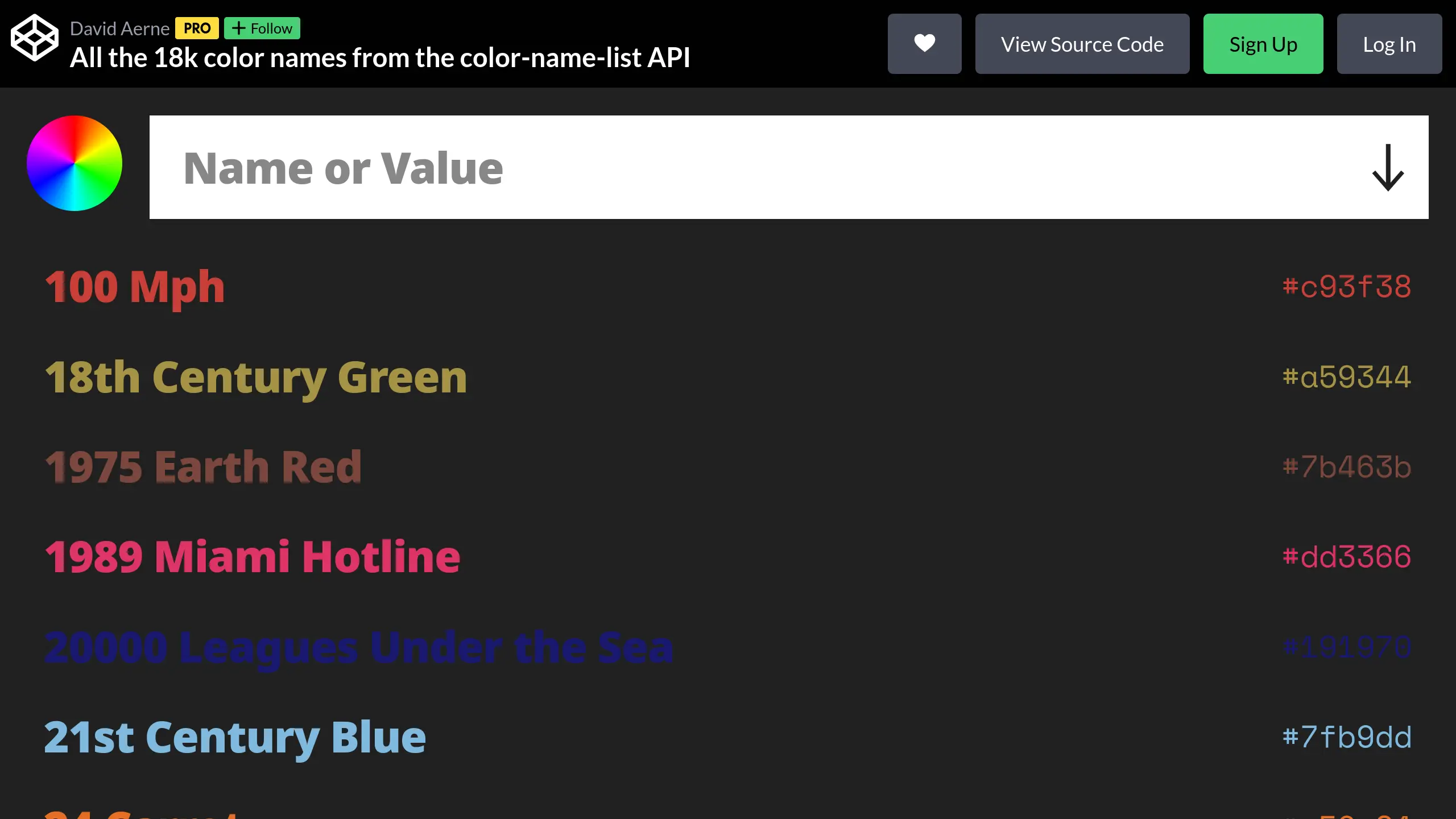
duckduckgo for a while and came across color-names. It is a list of colors with the name of the
color being something a human would say, like the ones below. I knew this was perfect for semantic search.
So... uhh....
A thesaurus that needs a graphics card
(ㆆ_ㆆ)
- I tested semantic search with just the key value pairs from
colors.json, but the results were underwhelming. So I decided to add another layer of computa- ahem, intelligence to the program. My plan was something like this:
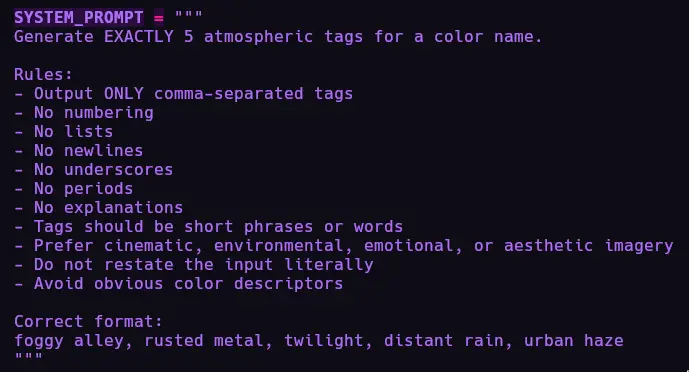
We get a tiny LLM to take the color names as input and generate 5 other words/phrases that could match it closely. Then we find the embeddings of these. This would make it drastically easy for the embedding model to match an input prompt to any of the colors.
Semantic Search Implementation
- I searched ollama's model directory for newer and smaller models. I found a few that would fit my use case. all-minilm, and snowflake-arctic-embed and IBM's embedding model: Granite. I went on to benchmark some of the Embedding Models (I call it the great Embedding Model BakeOff May Week-4 2026 Edition to see which of these cooks my PC first).
| Model | Time Taken | Quality (opinionated) | Notes | Results |
|---|---|---|---|---|
| granite:33m | 00:16:03 | linkedin 🧠📉 |
i would use rapidfuzz or pywal instead, like a cavemanTruth be told, it seems like this is better for RAG than creative tasks. Still very 🧠🪦 |
check here |
| all-minilm:22m | 00:09:52 | excellent | it's better than 33m variant, but feels robotic | check here |
| all-minilm:33m | 00:11:13 | good | no soul + a bit corpo | check here |
| snowflake-arctic-embed:22m | 00:08:07 | excellent | perfect model for this use case | check here |
| snowflake-arctic-embed:33m | 00:09:36 | good | loses character compared to smaller model | check here |
larger modelsnomic-embed-moe, bge-m3, mxbai-embed-large |
1-2 hours | bad | not really good for this use case |
NAnot gonna waste any more time |
I just like Qwen alirght?
Definitely not sponsored by Alibaba...
shhh...
- I also benchmarked a few qwen LLMs as well. Below are the results of the LLM BakeOff May Week-4 2026 Edition:
- These models actually got close to baking-off my PC, even 1 generation was taking close to 20
seconds sometimes, and I had to do this for 31k colors. I did the "smart thing" and ran it for a
few demo prompts only. Therefore, the results may not be perfect. Upon that, I believe my prompt
engineering could be better. I got ChatGPT to make this prompt for me because I'm not that good at talking to
small LLMS. Generating tags for each of the colors using
Qwen 3.5: 0.5btook approximately 6 hours. - Now that the
LLM had generated~5 (excluding negative prompts which were filtered) extra tags for each of the 31k colors, I ran a loop, found embeddings for all of them and saved them in numpy verctor arrays, because we gonna do somevector math. This process took approximately 8 minutes. - Now, I just have to make a script where I ask for a mood and the python script does the
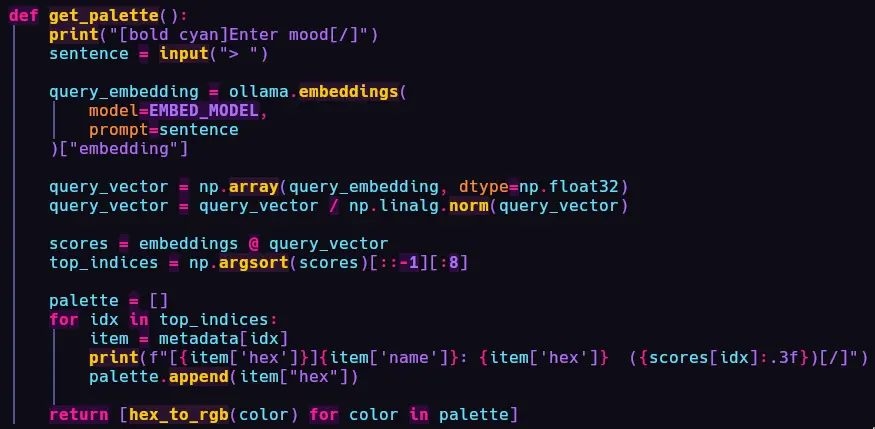
semantic searchin the numpy vector array and ranks the top 8 colors with the most embedding matching. It first generates an embedding for input text, then searches the array usingcosine similarity.
| Model | Speed | Quality | Notes |
|---|---|---|---|
| qwen3.5:0.8b | medium | Best overall | Good creativity |
| qwen3:4b | slowest | Straight up bad | "aktually 🤓☝️" and harder to follow rules |
| qwen3:1.7b | fast | Cinematic | Very good but always "soft glow", "ethereal", "muted tones" |
| qwen3:0.6b | fast | Repetitive | Same as 1.7b but obsessed with "ethereal" |
| qwen2.5:0.5b | fastest | Alright | Very basic model, just sticks to catchphrases like "ethereal" |
Prompt to run it locally on my 3GB vram GTX 1060.
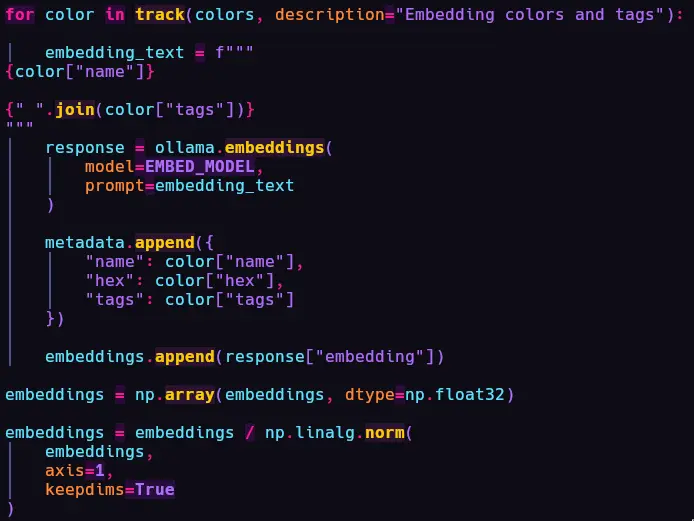
So it finds the "direction" of the input phrase.
Get it? Get it?
(✖╭╮✖)
Ugh...
nevermind
- After this, I simply use the same
Gradient Light from earlier and TA-DA!!
Youtube Demo
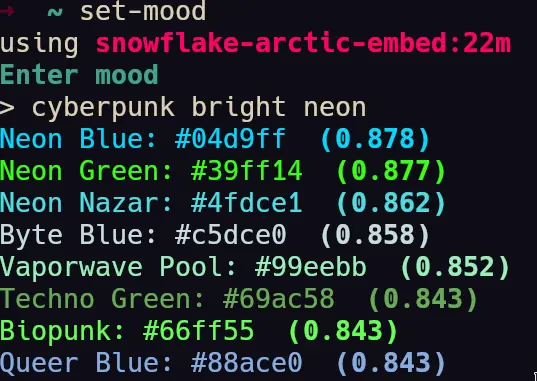
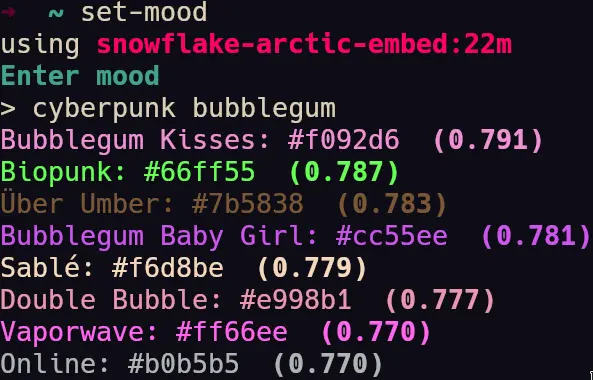
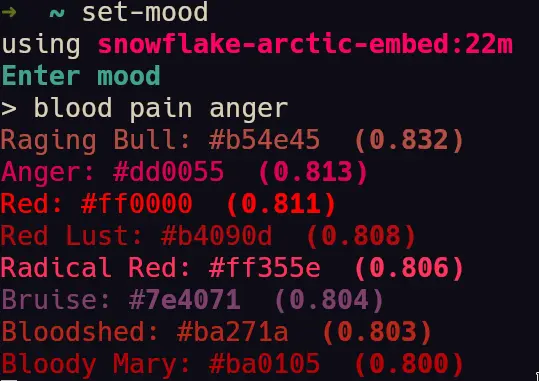
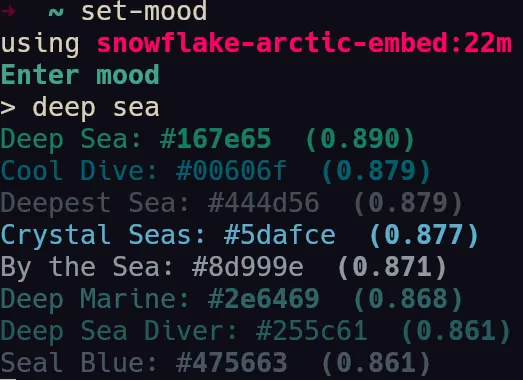
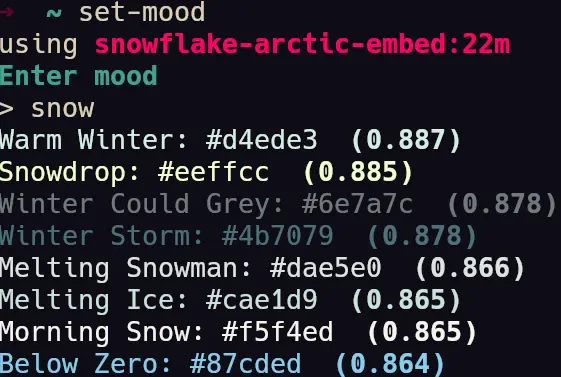
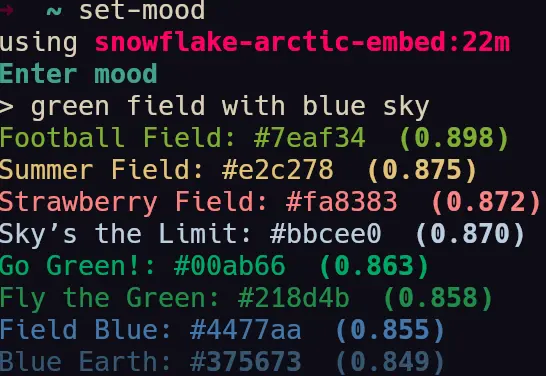
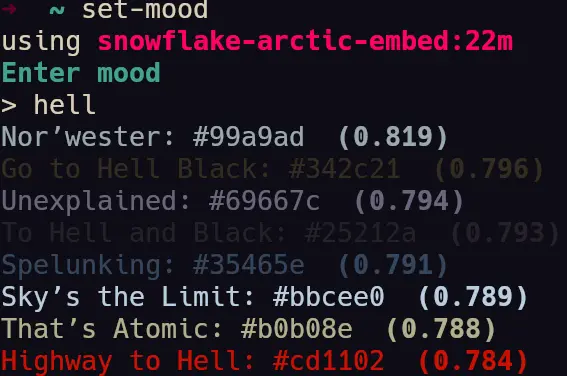
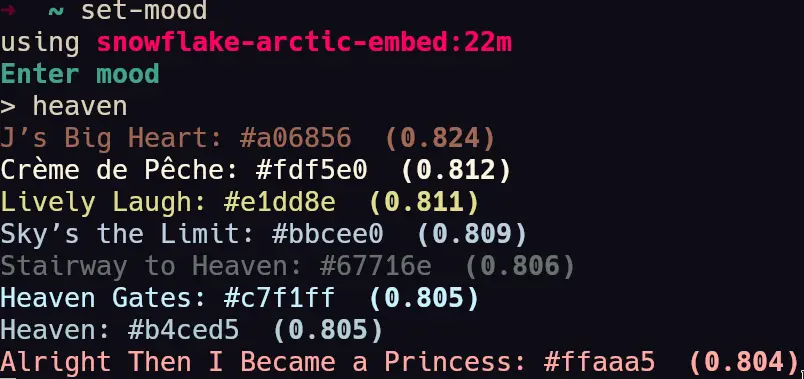
- A few screenshots of the colors being generated by the semantic engine.
- Yet to record, edit and upload video